Radiomics-Guided Prediction of Histopathological Aggressiveness and Margin Status in Solid Organ Malignancies: A Comprehensive Systematic Review Study
Keywords:
Radiomics, Neoplasms, Diagnostic Imaging, Artificial Intelligence, Machine Learning, Neoplasm GradingAbstract
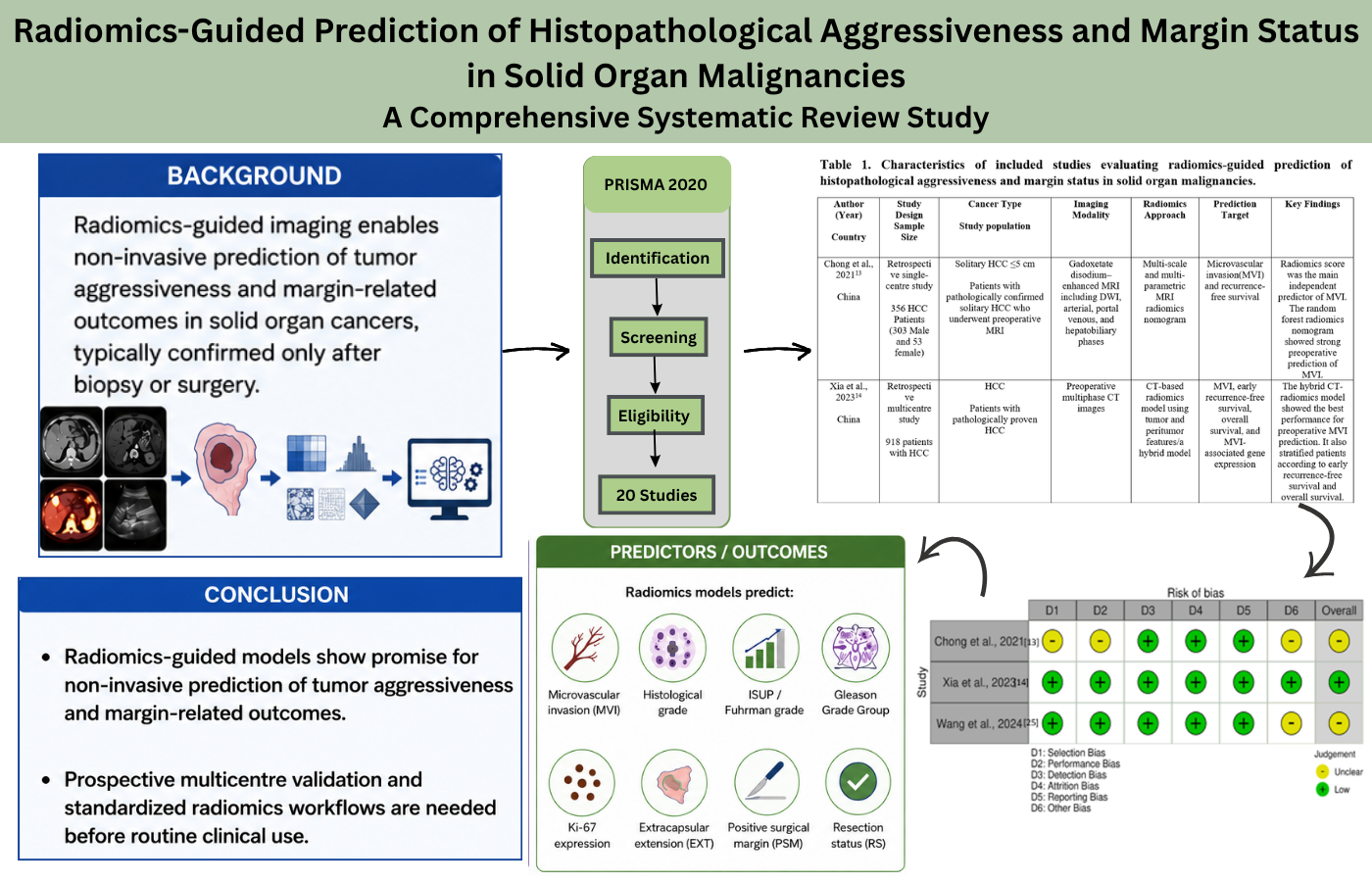
Background: Radiomics-guided imaging has become a promising non-invasive strategy to assess tumor biology characteristics in solid organ malignancies. Microvascular invasion, tumour grade, Ki-67 expression, Gleason Grade Group, ISUP grade, extracapsular extension, and margin status are all significant features that can be used to determine the aggressiveness of the condition, but are only confirmed after biopsy or surgery. The current study aims to summarize the evidence of the use of radiomics for the prediction of the histopathological aggressiveness and margin-related outcome in solid organ cancers. Methodology: This systematic review followed PRISMA 2020 guidelines. PubMed, Scopus, Web of Science, and Google Scholar databases were used to search for publications from January 2019 until February 2026. Studies that used full-text were included, and they were original studies using either CT, MRI, PET/CT, or ultrasound-based radiomics or machine-learning models. Eligible studies provided a prediction of pathological aggressiveness, margin status, or survival-related outcomes. Only articles reporting the results of a study with relevant outcomes were included. The certainty of evidence was estimated with GRADE and the risk of bias with QUADAS-2 and PROBAST. Results: 16 studies were included in the analysis from 512 records identified. The studies included in this were HCC, prostate cancer, renal cell cancer, PDA, and PNET. Predictive value of radiomics models was promising for the prediction of microvascular invasion, histological grade, ISUP/Fuhrman grade, Gleason Grade Group, Ki-67 expression, EXT, PSM, RS, and survival outcomes. The level of certainty was low to moderate, and the scores of most studies were medium. Conclusion: Radiomics-guided models could facilitate non-invasive prediction of tumor aggressiveness and margin-related outcomes, but need to be validated in a prospective multicentre study and standardized radiomics workflows prior to their routine use in clinical practice.
References
1. Colonna G. Overcoming barriers in cancer biology research: current limitations and solutions. Cancers (Basel). 2025 Jun;17(13):2102. https://doi.org/10.3390/cancers17132102
2. Sandilya U, Mamatha K. Expression of Ki-67 in invasive breast carcinoma and its correlation with different clinicopathological features. Cureus. 2024 Sep;16(9). https://doi.org/10.7759/cureus.69820
3. Cheng DO, Khaw CR, McCabe J, Pennycuick A, Nair A, Moore DA, et al. Predicting histopathological features of aggressiveness in lung cancer using CT radiomics: a systematic review. Clin Radiol. 2024 Sep;79(9):681-689. https://doi.org/10.1016/j.crad.2024.04.022
4. Pham D, Tabba D, Zhou C, Chow C, Elsensohn A. Histopathological discrepancy of biopsy specimens compared to subsequent Mohs surgery or wide local excision specimens. J Am Acad Dermatol. 2024 Sep;91(3):518-519. https://doi.org/10.1016/j.jaad.2024.04.047
5. Neha F, Shukla DK. Radiomics in medical imaging: methods, applications, and challenges. J Imaging. 2026 May;12(6):220. https://doi.org/10.3390/jimaging12060220
6. Jiang L, You C, Xiao Y, Wang H, Su GH, Xia BQ, et al. Radiogenomic analysis reveals tumor heterogeneity of triple-negative breast cancer. Cell Rep Med. 2022 Jul;3(7):100694. https://doi.org/10.1016/j.xcrm.2022.100694
7. Lin ZY, Chen K, Chen JR, Chen WX, Li JF, Li CG, et al. Deep neural network and radiomics-based magnetic resonance imaging system for predicting microvascular invasion in hepatocellular carcinoma. J Cancer. 2024;15(19):6223-6231. https://doi.org/10.7150/jca.93712
8. Ning J, Spielvogel CP, Haberl D, Trachtova K, Stoiber S, Rasul S, et al. A novel assessment of whole-mount Gleason grading in prostate cancer to identify candidates for radical prostatectomy: a machine learning-based multiomics study. Theranostics. 2024;14(12):4570-4581. https://doi.org/10.7150/thno.96921
9. Litjens G, Broekmans JPEA, Boers T, Caballo M, van den Hurk MHF, Ozdemir D, et al. Computed tomography-based radiomics using tumor and vessel features to assess resectability in cancer of the pancreatic head. Diagnostics. 2023;13(20):3198. https://doi.org/10.3390/diagnostics13203198
10. Page MJ, McKenzie JE, Bossuyt PM, Boutron I, Hoffmann TC, Mulrow CD, et al. The PRISMA 2020 statement: an updated guideline for reporting systematic reviews. Syst Rev. 2021;10(1):89. https://doi.org/10.1186/s13643-021-01626-4
11. Leucuța DC, Urda-Cîmpean AE, Istrate D, Drugan T. Risk of bias assessment of diagnostic accuracy studies using QUADAS 2 by large language models. Diagnostics (Basel). 2025 Jun;15(12):1451. https://doi.org/10.3390/diagnostics15121451
12. Wolff RF, Moons KGM, Riley RD, Whiting PF, Westwood M, Collins GS, et al. PROBAST: a tool to assess the risk of bias and applicability of prediction model studies. Ann Intern Med. 2019 Jan;170(1):51-58. https://doi.org/10.7326/M18-1376
13. Chong HH, Yang L, Sheng RF, Yu YL, Wu DJ, Rao SX, et al. Multi-scale and multi-parametric radiomics of gadoxetate disodium-enhanced MRI predicts microvascular invasion and outcome in patients with solitary hepatocellular carcinoma ≤5 cm. Eur Radiol. 2021;31(7):4824-4838. https://doi.org/10.1007/s00330-020-07601-2
14. Xia TY, Zhou ZH, Meng XP, Zha JH, Yu Q, Wang WL, et al. Predicting microvascular invasion in hepatocellular carcinoma using CT-based radiomics model. Radiology 2023 May;307(4):e222729. https://doi.org/10.1148/radiol.222729
15. Mao Y, Wang J, Zhu Y, Chen J, Mao L, Kong W, et al. Gd-EOB-DTPA-enhanced MRI radiomic features for predicting histological grade of hepatocellular carcinoma. Hepatobiliary Surg Nutr. 2022 Feb;11(1):13-24. https://doi.org/10.21037/hbsn-19-870
16. Zhang R, Xu L, Wen X, Zhang J, Yang P, Zhang L, et al. A nomogram based on bi-regional radiomics features from multimodal magnetic resonance imaging for preoperative prediction of microvascular invasion in hepatocellular carcinoma. Quant Imaging Med Surg. 2019 Sep;9(9):1503-1515. https://doi.org/10.21037/qims.2019.09.07
17. He D, Wang X, Fu C, Wei X, Bao J, Ji X, et al. MRI-based radiomics models to assess prostate cancer, extracapsular extension and positive surgical margins. Cancer Imaging. 2021;21(1):46. https://doi.org/10.1186/s40644-021-00414-6
18. Zamboglou C, Carles M, Fechter T, Kiefer S, Reichel K, Fassbender TF, et al. Radiomic features from PSMA PET for non-invasive intraprostatic tumor discrimination and characterization in patients with intermediate- and high-risk prostate cancer: a comparison study with histology reference. Theranostics. 2019;9(9):2595-2605. https://doi.org/10.7150/thno.32376
19. Qiao X, Gu X, Liu Y, Shu X, Ai G, Qian S, et al. MRI radiomics-based machine learning models for Ki67 expression and Gleason grade group prediction in prostate cancer. Cancers. 2023 Sep;15(18):4536. https://doi.org/10.3390/cancers15184536
20. Yang L, Jin P, Qian J, Qiao X, Bao J, Wang X. Value of a combined magnetic resonance imaging-based radiomics-clinical model for predicting extracapsular extension in prostate cancer: a preliminary study. Transl Cancer Res. 2023 Jul;12(7):1787-1801. https://doi.org/10.21037/tcr-22-2750
21. Pan L, Chen M, Sun J, Jin P, Ding J, Cai P, et al. Prediction of Fuhrman grade of renal clear cell carcinoma by multimodal MRI radiomics: a retrospective study. Clin Radiol. 2024 Feb;79(2). https://doi.org/10.1016/j.crad.2023.11.006
22. Cheng D, Abudikeranmu Y, Tuerdi B. Differentiation of clear cell and non-clear-cell renal cell carcinoma through CT-based radiomics models and nomogram. Curr Med Imaging. 2023 Aug;19(9):1005-1017. https://doi.org/10.2174/1573405619666221121164235
23. Jiao P, Wang B, Ni X, Lu Y, Yang R, Liu Y, et al. CT urography-based radiomics to predict ISUP grading of clear cell renal cell carcinoma. J Cancer. 2025;16(4):1118-1126. https://doi.org/10.7150/jca.105173
24. Aymerich M, García-Baizán A, Franco PN, González M, San Miguel Fraile P, Ortiz-Rey JA, et al. Radiomics-based classification of clear cell renal cell carcinoma ISUP grade: a machine learning approach with SHAP-enhanced explainability. Diagnostics. 2025 May;15(11):1337. https://doi.org/10.3390/diagnostics15111337
25. Wang K, Karalis JD, Elamir A, Bifolco A, Wachsmann M, Capretti G, et al. Delta radiomic features predict resection margin status and overall survival in neoadjuvant-treated pancreatic cancer patients. Ann Surg Oncol. 2024 Apr;31(4):2608-2620. https://doi.org/10.1245/s10434-023-14805-5
26. Zhu HB, Zhu HT, Jiang L, Nie P, Hu J, Tang W, et al. Radiomics analysis from magnetic resonance imaging in predicting the grade of nonfunctioning pancreatic neuroendocrine tumors: a multicenter study. Eur Radiol. 2024 Jan;34(1):90-102. https://doi.org/10.1007/s00330-023-09957-7
27. Javed AA, Zhu Z, Kinny-Köster B, Habib JR, Kawamoto S, Hruban RH, et al. Accurate non-invasive grading of nonfunctional pancreatic neuroendocrine tumors with a CT-derived radiomics signature. Diagn Interv Imaging. 2024 Jan;105(1):33-39. https://doi.org/10.1016/j.diii.2023.08.002
28. Dong Y, Yang DH, Tian XF, Lou WH, Wang HZ, Chen S, et al. Pancreatic neuroendocrine tumor: prediction of tumor grades by radiomics models based on ultrasound images. Br J Radiol. 2023 Sep;96(1149):20220783. https://doi.org/10.1259/bjr.20220783
29. Li J, Song W, Li J, Cai L, Jiang Z, Wei M, et al. A clinical study exploring the prediction of microvascular invasion in hepatocellular carcinoma through the use of combined enhanced CT and MRI radiomics. PLoS One. 2025;20(1):e0318232. https://doi.org/10.1371/journal.pone.0318232
30. Gu D, Hu Y, Ding H, Wei J, Chen K, Liu H, et al. CT radiomics may predict the grade of pancreatic neuroendocrine tumors: a multicenter study. Eur Radiol. 2019 Dec;29(12):6880-6890. https://doi.org/10.1007/s00330-019-06176-x
31. Zhong H, Zhang Y, Zhu G, Zheng X, Wang J, Kang J, et al. Preoperative prediction of microvascular invasion and relapse-free survival in hepatocellular carcinoma ≥3 cm using CT radiomics: development and external validation. BMC Med Imaging. 2025;25(1):141. https://doi.org/10.1186/s12880-025-01677-2
32. Cao X, Yang H, Luo X, Zou L, Zhang Q, Li Q, et al. A Cox nomogram for assessing recurrence-free survival in hepatocellular carcinoma following surgical resection using dynamic contrast-enhanced MRI radiomics. J Magn Reson Imaging. 2023 Dec;58(6):1930-1941. https://doi.org/10.1002/jmri.28725
33. Hu X, Li C, Wang Q, Wu X, Chen Z, Xia F, et al. Development and external validation of a radiomics model derived from preoperative gadoxetic acid-enhanced MRI for predicting histopathologic grade of hepatocellular carcinoma. Diagnostics. 2023;13(3):413. https://doi.org/10.3390/diagnostics13030413
34. Wei G, Fang G, Guo P, Fang P, Wang T, Lin K, et al. Preoperative prediction of microvascular invasion risk in hepatocellular carcinoma with MRI: peritumoral versus tumor region. Insights Imaging. 2024;15(1):188. https://doi.org/10.1186/s13244-024-01760-2
35. Yang J, Dong X, Jin S, Chen J, Li Y, Wang G, et al. Radiomics model of dynamic contrast-enhanced MRI for evaluating vessels encapsulating tumor clusters and microvascular invasion in hepatocellular carcinoma. Acad Radiol. 2025 Jan;32(1):146-156. https://doi.org/10.1016/j.acra.2024.03.048
36. Van den Berg I, Soeterik TFW, van der Hoeven EJRJ, Claassen B, Brink WM, Baas DJH, et al. The development and external validation of artificial intelligence-driven MRI-based models to improve prediction of lesion-specific extraprostatic extension in patients with prostate cancer. Cancers (Basel). 2023 Nov;15(22):5452. https://doi.org/10.3390/cancers15225452
37. Cuocolo R, Stanzione A, Faletti R, Gatti M, Calleris G, Fornari A, et al. MRI index lesion radiomics and machine learning for detection of extraprostatic extension of disease: a multicenter study. Eur Radiol. 2021 Oct;31(10):7575-7583. https://doi.org/10.1007/s00330-021-07856-3
38. Jafari E, Zarei A, Dadgar H, Keshavarz A, Abdollahi H, Samimi R, et al. Efficacy of PSMA PET/CT radiomics analysis for risk stratification in newly diagnosed prostate cancer: a multicenter study. BMC Med Imaging. 2025;25(1). https://doi.org/10.1186/s12880-025-01914-8
39. Bai H, Xia W, Ji X, Zhao X, Bao J, Zhou J, et al. Multiparametric magnetic resonance imaging-based peritumoral radiomics for preoperative prediction of the presence of extracapsular extension with prostate cancer. J Magn Reson Imaging. 2021 Oct;54(4):1222-1230. https://doi.org/10.1002/jmri.27678
40. Cui E, Li Z, Ma C, Li Q, Lei Y, Lan Y, et al. Predicting the ISUP grade of clear cell renal cell carcinoma with multiparametric MR and multiphase CT radiomics. Eur Radiol. 2020 May;30(5):2912-2921. https://doi.org/10.1007/s00330-019-06601-1
Downloads
Published
Issue
Section
License
Copyright (c) 2026 Laiba Akram, Muhammad Arsalan (Author)

This work is licensed under a Creative Commons Attribution-NonCommercial 4.0 International License.
Journal of Surgery and Advanced Medical Research (JSAMR) follows the Attribution Creative Commons-Non commercial (CC BY-NC) license which allows the users to copy and redistribute the material in any medium or format, remix, transform and build upon the material. The users must give credit to the source and indicate, provide a link to the license, and indicate if changes were made. However, the CC BY-NC license restricts the use of material for commercial purposes (Further details are available at website. The Editorial Board of the JSAMR endeavors to ensure the accuracy, integrity, and quality of all published content. However, the responsibility of opinions, interpretations, and conclusions expressed in the published articles rests entirely with the authors and do not necessarily reflect the views of the Editorial Board, publisher, or affiliated institutions.