Identification of Common Uropathogens in Patients with Culture-Confirmed Urinary Tract Infection
Keywords:
Urinary Tract Infection, Diagnostics, Antibiotics, Nephrology, uropathogens, antimicrobial resistance, multidrug resistance, Klebsiella pneumoniae, antimicrobial susceptibilityAbstract
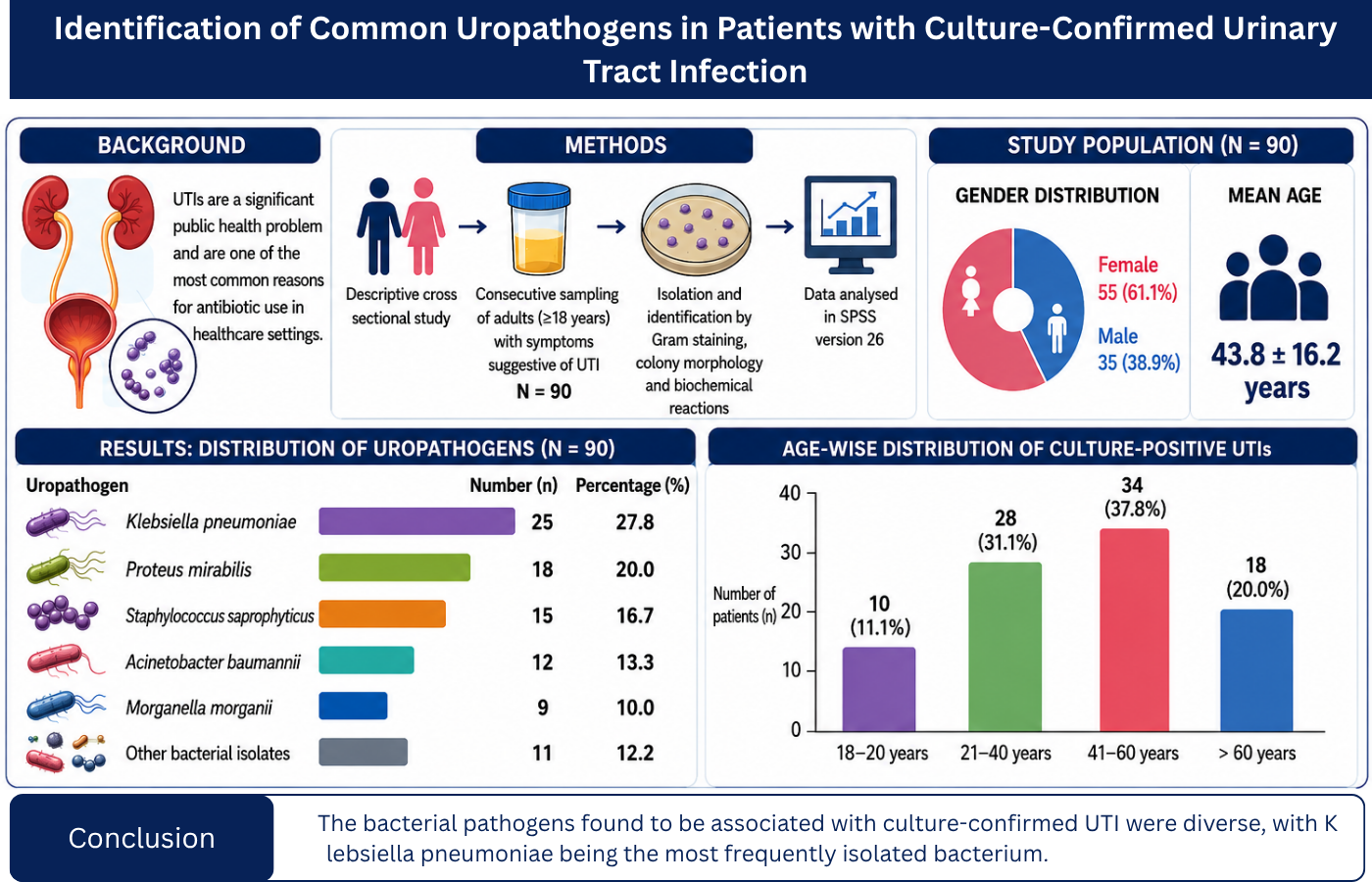
Background: Urinary tract infections (UTIs) are a major burden on the health care system and are the most common reason for antibiotic prescriptions in health care. The objectives of this study were to identify the spectrum of bacterial pathogens associated with culture-proven UTI and their antimicrobial resistance patterns and associated clinical parameters. Methodology: This cross-sectional study (n=90) included a structured data collection form that was used to gather the demographic and clinical information. The urine samples were analyzed in the usual way for bacteriological identification and antimicrobial susceptibility testing. Frequencies of the bacterial isolates, antimicrobial susceptibility patterns, multidrug-resistant (MDR) organisms and factors associated with the MDR infections were determined (SPSS 26.0, P-value<0.05). Results: The mean age of the participants was 43.8 ± 16.2 years, and 61.1% were women. Klebsiella pneumoniae (27.8%), Proteus mirabilis (20.0%) and Staphylococcus saprophyticus (16.7%) were the most common uropathogens found. There were significant differences in the distribution of pathogens between age groups and between gender (p < 0.05). Antimicrobial susceptibility testing revealed that the highest sensitivity was to imipenem (88.9%), amikacin (81.1%) and nitrofurantoin (76.7%), while high resistance rates were seen in ceftriaxone (61.1%) and ciprofloxacin (57.8%). Twenty-three percent of isolates were predicted to produce extended-spectrum beta-lactamase and 37.8% were multidrug resistant. Diagnostic logistic regression analysis showed that diabetes mellitus (p = 0.024; OR = 2.81) and recurrent UTI (p = 0.007; OR = 3.47) were the significant factors. Conclusion: Klebsiella pneumoniae is the most frequent pathogen of culture-confirmed UTIs, and Gram-negative organisms continue to be the major cause of UTIs.
References
1. Yang X, Chen H, Zheng Y, Qu S, Wang H, Yi F. Disease burden and long-term trends of urinary tract infections: a worldwide report. Front Public Health. 2022;10:888205. https://doi.org/10.3389/fpubh.2022.888205
2. Czajkowski K, Broś-Konopielko M, Teliga-Czajkowska J. Urinary tract infection in women. Prz Menopauzalny. 2021 Apr 21;20(1):40-47. https://doi.org/10.5114/pm.2021.105382
3. Glover EK, Sheerin NS. Urinary tract infection. Medicine. 2023 Apr;51(4):239-243. https://doi.org/10.1016/j.mpmed.2023.01.002
4. Franco JVA, Meza N. Advances in the diagnosis of urinary tract infection: a narrative review. Urogenit Tract Infect. 2025;20(1):17-27. https://doi.org/10.14777/uti.2550020010
5. Flores-Mireles AL, Walker JN, Caparon M, Hultgren SJ. Urinary tract infections: epidemiology, mechanisms of infection and treatment options. Nat Rev Microbiol. 2015 May;13(5):269-284. https://doi.org/10.1038/nrmicro3432
6. Ait-Mimoune N, Hassaine H, Boulanoir M. Bacteriological profile of urinary tract infections and antibiotic susceptibility of Escherichia coli in Algeria. Iran J Microbiol. 2022 Apr;14(2):156-160. https://doi.org/10.18502/ijm.v14i2.9180
7. Prorok P, Bierowiec K, Skrok M, Karwańska M, Siedlecka M, Miszczak M, et al. Characteristics of Staphylococcus saprophyticus isolated from humans and animals. Int J Mol Sci. 2025;26(14):6885. https://doi.org/10.3390/ijms26146885
8. Kot B, Grużewska A, Szweda P, Wicha J, Parulska U. Antibiotic resistance of uropathogens isolated from patients hospitalized in district hospital in Central Poland in 2020. Antibiotics (Basel). 2021 Apr 16;10(4):447. https://doi.org/10.3390/antibiotics10040447
9. Anton CI, Ștefan I, Zamfir M, Ghiațău CF, Sima CS, Osman CL, et al. Etiology and risk factors of recurrent urinary tract infections in women in a multidisciplinary hospital in Romania. Microorganisms. 2025;13(3):626. https://doi.org/10.3390/microorganisms13030626
10. Dudzik Ł, Krzyżek P, Dworniczek E. A review on the current and future state of urinary tract infection diagnostics. Int J Mol Sci. 2025 Nov 8;26(22):10847. https://doi.org/10.3390/ijms262210847
11. Turcu FL, Vacaroiu IA, Balcangiu-Stroescu AE, Mitrea AR, Miricescu D, Balan DG, et al. Recurrent urinary tract infections in female patients: a clinical review. J Mind Med Sci. 2025;12(1):5. https://doi.org/10.3390/jmms12010005
12. Wireko S, Ngmaakan G, Dwomoh D, Hansen C, Nartey S, Senu E. Regional burden of urinary tract infection, its aetiologies, and antibiotic resistance patterns, 2020-2023: a retrospective study. Health Sci Rep. 2025;8(11). https://doi.org/10.1002/hsr2.71503
13. Khalid F, Aljohani WJ, Akram A, Bukhari A, Khojah OT. Epidemiology and antimicrobial resistance of uropathogens in a tertiary care center in Riyadh, Saudi Arabia: a one-year retrospective analysis. Pathogens. 2025;14(12):1254. https://doi.org/10.3390/pathogens14121254
14. Wajid H, Manzoor H, Manzoor M, Mirza S, Khan HS, Hassan S, et al. Recurrent urinary tract infection in diabetics: a retrospective analysis. Cureus. 2025;17(7). https://doi.org/10.7759/cureus.87816
15. Morad DSH, Oubid SH, Dhannoon NA, Saadi AM. Aetiology of urinary tract infection: a review. Int J Med All Body Health Res. 2024 Jul;5(3):1-7. https://doi.org/10.54660/IJMBHR.2024.5.3.01-07
16. Mukubwa GK, Lukusa FN, Kavulikirwa OK, Iyamba JML, Tshilolo LM, Memvanga PB. Resistance profiles of urinary Escherichia coli and Klebsiella pneumoniae isolates to antibiotics commonly prescribed for treatment of urinary tract infections at Monkole Hospital Center, Kinshasa, Democratic Republic of the Congo. Afr J Clin Exp Microbiol. 2023 Jan;24(1):51-60. https://doi.org/10.4314/ajcem.v24i1.7
17. Whelan S, Lucey B, Finn K. Uropathogenic Escherichia coli (UPEC)-associated urinary tract infections: the molecular basis for challenges to effective treatment. Microorganisms. 2023 Aug 28;11(9):2169. https://doi.org/10.3390/microorganisms11092169
18. Armbruster CE, Mobley HLT, Pearson MM. Pathogenesis of Proteus mirabilis infection. EcoSal Plus. 2018 Feb 8;8(1):10.1128/ecosalplus.ESP-0009-2017. https://doi.org/10.1128/ecosalplus.esp-0009-2017
19. Kline KA, Lewis AL. Gram-positive uropathogens, polymicrobial urinary tract infection, and the emerging microbiota of the urinary tract. Microbiol Spectr. 2016;4(2):10.1128/microbiolspec.UTI-0012-2012. https://doi.org/10.1128/microbiolspec.UTI-0012-2012
20. Nocera FP, Attili AR, De Martino L. Acinetobacter baumannii: its clinical significance in human and veterinary medicine. Pathogens. 2021 Jan 27;10(2):127. https://doi.org/10.3390/pathogens10020127
21. Altamimi E, Saqan R, Alshurman MA, Shalakhti TA, Tashtoush H. Morganella morganii urinary tract infection in Jordanian children: case series from a tertiary hospital. Infect Chemother. 2025 Dec;57(4):522-530. https://doi.org/10.3947/ic.2025.0066
22. Pietrucha-Dilanchian P, Hooton TM. Diagnosis, treatment, and prevention of urinary tract infection. Microbiol Spectr. 2016 Dec 16;4(6):10.1128/microbiolspec.UTI-0021-2015. https://doi.org/10.1128/microbiolspec.uti-0021-2015
23. van der Velden LB, Tromp M, Bleeker-Rovers CP, Hulscher M, Kullberg BJ, Mouton JW, et al. Non-adherence to antimicrobial treatment guidelines results in more broad-spectrum but not more appropriate therapy. Eur J Clin Microbiol Infect Dis. 2012 Jul;31(7):1561-1568. https://doi.org/10.1007/s10096-011-1478-5
24. Jumaah OH, Abdel Rasool AM, Naser LA. Prevalence and antibiotic resistance patterns of uropathogens in patients with urinary tract infections. Academia Open. 2025 Oct;10(2). https://doi.org/10.21070/acopen.10.2025.12847
Downloads
Published
Issue
Section
License
Copyright (c) 2026 Ejaz Ahmed, Warda Azhar (Author)

This work is licensed under a Creative Commons Attribution-NonCommercial 4.0 International License.
Journal of Surgery and Advanced Medical Research (JSAMR) follows the Attribution Creative Commons-Non commercial (CC BY-NC) license which allows the users to copy and redistribute the material in any medium or format, remix, transform and build upon the material. The users must give credit to the source and indicate, provide a link to the license, and indicate if changes were made. However, the CC BY-NC license restricts the use of material for commercial purposes (Further details are available at website. The Editorial Board of the JSAMR endeavors to ensure the accuracy, integrity, and quality of all published content. However, the responsibility of opinions, interpretations, and conclusions expressed in the published articles rests entirely with the authors and do not necessarily reflect the views of the Editorial Board, publisher, or affiliated institutions.