Clinical Characteristics and Treatment Patterns of Patients with Colorectal Cancer
Keywords:
Colorectal cancer, clinical characteristics, treatment patterns, chemotherapy, tumor staging, oncology, colorectal malignancyAbstract
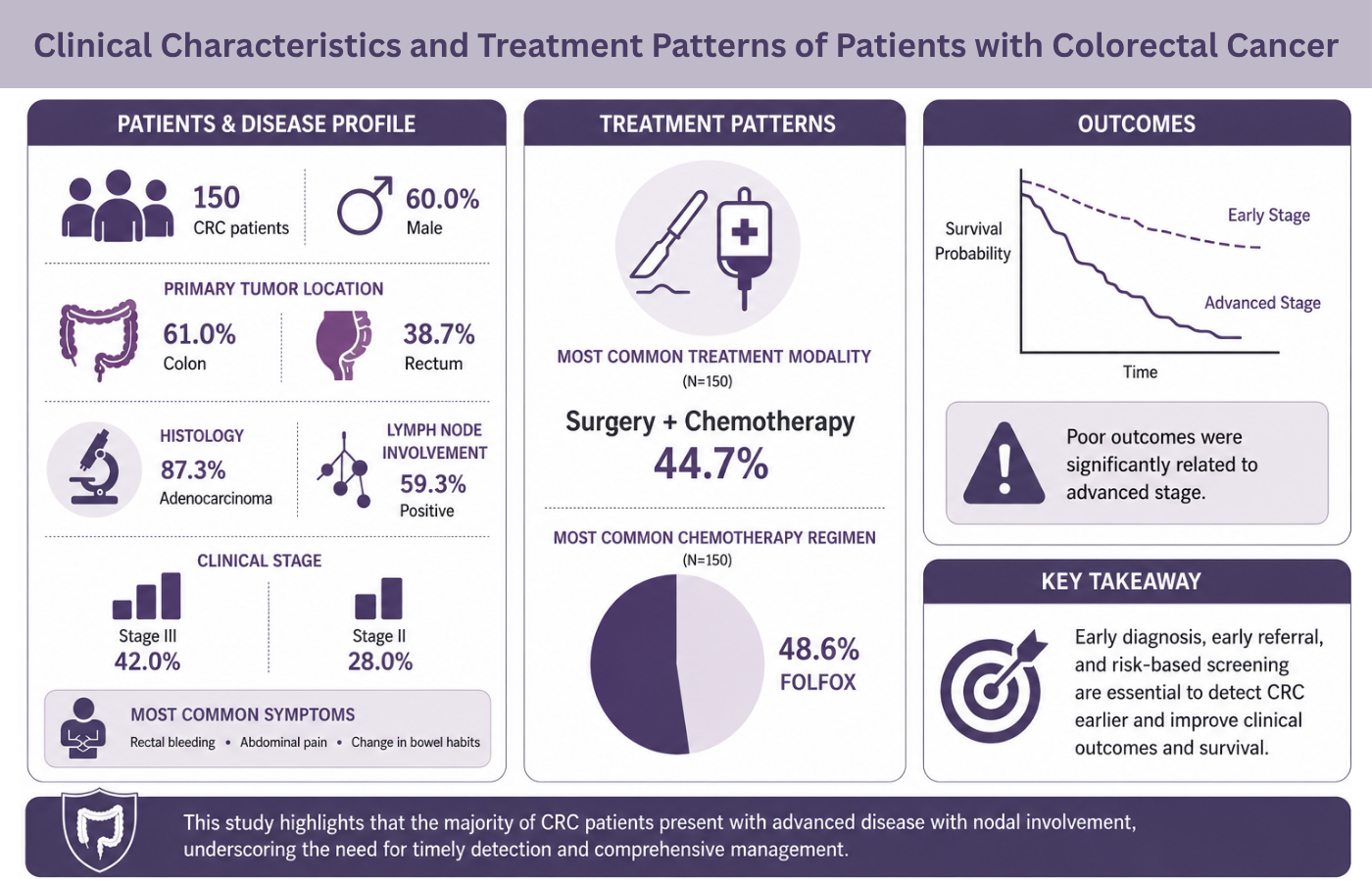
Background: Colorectal cancer (CRC) is regarded as one of the most frequently occurring cancers in the world, and an important cause of morbidity and mortality in cancer patients. The current study aimed to evaluate the characteristics, tumor profile, treatment, and factors related to advanced colorectal cancer. Methods: This cross-sectional analytical study used a descriptive approach (n=150) including colorectal cancer patients who were diagnosed histopathologically in the oncological and surgical department of tertiary care hospitals. The data was collected through a data collection form, and the information collected included the demographic characteristics, clinical symptoms, location of the tumor, histological type, tumor grade, status of lymph nodes, clinical stage, treatment modalities, chemotherapy regimen, and clinical outcomes (SPSS version 24.0). Results: The mean age was 58.7 ± 12.1 years, and 60.0% were male. Sixty-one percent of patients had colon tumors, and 38.7% had rectal tumors. The most frequently occurring histological diagnosis was adenocarcinoma (87.3%), with involvement of the lymph nodes seen in 59.3%. Stage III disease was the most common (42.0%), and Stage II was the second most common (28.0%). The most frequently used treatment modality was surgery with chemotherapy (44.7%), and the most frequently used chemotherapy was FOLFOX (48.6%). Poor outcomes were significantly related to the advanced stage. Conclusions: There was a strong need for early diagnosis, early referral, and risk-based screening for better clinical outcomes and survival, as the majority of patients presented with advanced disease with nodal involvement.
References
1. Agrawal N, Lanjhiyana SK, Jaiswal M, Siddiqui MA, Gupta S. Colorectal cancer spectrum: From subtypes and epidemiology to oncotherapies. Gastroenterology & Endoscopy. 2025 Apr;3(2):55-64. https://doi.org/10.1016/j.gande.2025.01.002
2. Roshandel G, Ghasemi-Kebria F, Malekzadeh R. Colorectal cancer: epidemiology, risk factors, and prevention. Cancers (Basel). 2024 Apr 17;16(8):1530. https://doi.org/10.3390/cancers16081530
3. Boyapati HPN, Syeda STH, Saravanan A, Payidiparty D, Anbazhagan PK. Cracking the code of colorectal cancer screening: an overview with a focus on current and emerging screening methods. Cureus. 2025 May 24;17(5). https://doi.org/10.7759/cureus.84724
4. Mksyartinian P, Mohammad N, Wildgoose P, Stein BD. Understanding colorectal cancer patient experiences with family practitioners in Canada. Curr Oncol. 2024 Jun;31(6):3122-3148. https://doi.org/10.3390/curroncol31060237
5. Skalitzky MK, Zhou PP, Goffredo P, Guyton K, Sherman SK, Gribovskaja-Rupp I, et al. Characteristics and symptomatology of colorectal cancer in the young. Surgery. 2023 May;173(5):1137-1143. https://doi.org/10.1016/j.surg.2023.01.018
6. Chen K, Collins G, Wang H, Toh JWT. Pathological features and prognostication in colorectal cancer. Curr Oncol. 2021 Dec 13;28(6):5356-5383. https://doi.org/10.3390/curroncol28060447
7. Turkoglu E, Sarıyar Busery N, Yildirim S, Akdağ Topal G, Salman CB, Conay E, et al. Prognostic impact of tumor size in patients with Stage T3N1 colon cancer. J Clin Med. 2026;15(1):247. https://doi.org/10.3390/jcm15010247
8. Fleming M, Ravula S, Tatishchev SF, Wang HL. Colorectal carcinoma: pathologic aspects. J Gastrointest Oncol. 2012 Sep;3(3):153-173. https://doi.org/10.3978/j.issn.2078-6891.2012.030
9. Fadlallah H, El Masri J, Fakhereddine H, Youssef J, Chemaly C, Doughan S, et al. Colorectal cancer: recent advances in management and treatment. World J Clin Oncol. 2024 Sep 24;15(9):1136-1156. https://doi.org/10.5306/wjco.v15.i9.1136
10. Chowdhury D, Pond GR, Goffin JR. CAPOX vs. FOLFOX for colorectal cancer: real world outcomes in Ontario, Canada. Curr Oncol. 2025 Jul 31;32(8):435. https://doi.org/10.3390/curroncol32080435
11. Bichalski B, Bichalska-Lach M, Waniczek D. Diagnostic pathways and molecular biomarkers in colorectal cancer: current evidence and perspectives in Poland. Curr Issues Mol Biol. 2025;47(12):1047. https://doi.org/10.3390/cimb47121047
12. Khan WA, Parveen B, Asif M, Rathore MU, Rashid F, Tariq H, et al. Association of tumour budding with histological type and grade, pathological stage and lymph node metastasis in colorectal carcinoma. Pak Armed Forces Med J. 2024 Feb;74(1):206-210. https://doi.org/10.51253/pafmj.v74i1.10290
13. Elnaim ALK, Ali SSHM, Ahmed RSM, Sagap I, et al. Clinical profile, treatment patterns, and early outcomes of colorectal cancer at Kassala Police Hospital, Eastern Sudan: a 10-year retrospective cohort study. Sci Rep. 2026;16:16176. https://doi.org/10.1038/s41598-026-46785-3
14. Tsokkou S, Konstantinidis I, Papakonstantinou M, Chatzikomnitsa P, Liampou E, Toutziari E, et al. Sex differences in colorectal cancer: epidemiology, risk factors, and clinical outcomes. J Clin Med. 2025 Aug 6;14(15):5539. https://doi.org/10.3390/jcm14155539
15. González-Flores E, Garcia-Carbonero R, Élez E, Redondo-Cerezo E, Safont MJ, Vera García R. Gender and sex differences in colorectal cancer screening, diagnosis and treatment. Clin Transl Oncol. 2025;27(7):2825-2837. https://doi.org/10.1007/s12094-024-03801-0
16. Sung H, Siegel RL, Laversanne M, Jiang C, Morgan E, Zahwe M, et al. Colorectal cancer incidence trends in younger versus older adults: an analysis of population-based cancer registry data. Lancet Oncol. 2025 Jan;26(1):51-63. doi:10.1016/S1470-2045(24)00600-4.
17. Shaukat A, Kahi CJ, Burke CA, Rabeneck L, Sauer BG, Rex DK. ACG clinical guidelines: colorectal cancer screening 2021. Am J Gastroenterol. 2021 Mar;116(3):458-479. https://doi.org/10.14309/ajg.0000000000001122
18. Remo A, Fassan M, Vanoli A, Reggiani Bonetti L, Barresi V, Tatangelo F, et al. Morphology and molecular features of rare colorectal carcinoma histotypes. Cancers (Basel). 2019 Jul;11(7):1036. https://doi.org/10.3390/cancers11071036
19. Derwinger K, Kodeda K, Bexe-Lindskog E, Taflin H. Tumour differentiation grade is associated with TNM staging and the risk of node metastasis in colorectal cancer. Acta Oncol. 2010;49(1):57-62. https://doi.org/10.3109/02841860903334411
20. Kim HJ, Choi GS. Clinical implications of lymph node metastasis in colorectal cancer: current status and future perspectives. Ann Coloproctol. 2019 Jun;35(3):109-117. https://doi.org/10.3393/ac.2019.06.12
21. Khanum R, Ahmed HW, Khan SU, Tariq S. Colorectal cancer: determinants of delayed diagnosis and its association with survival in the Pakistani population. Pak J Med Dent. 2025 Apr;14(2):75-81. https://doi.org/10.36283/ziun-pjmd14-2/013
22. Demb J, Kolb JM, Dounel J, et al. Red flag signs and symptoms for patients with early-onset colorectal cancer: a systematic review and meta-analysis. JAMA Netw Open. 2024 May 24;7(5). https://doi.org/10.1001/jamanetworkopen.2024.13157
23. Benson AB, Venook AP, Al-Hawary MM, Arain MA, Chen YJ, Ciombor KK, et al. Colon cancer, Version 2.2021, NCCN Clinical Practice Guidelines in Oncology. J Natl Compr Canc Netw. 2021 Mar 2;19(3):329-359. https://doi.org/10.6004/jnccn.2021.0012
24. Sánchez-Gundín J, Fernández-Carballido AM, Martínez-Valdivieso L, Barreda-Hernández D, Torres-Suárez AI. New trends in the therapeutic approach to metastatic colorectal cancer. Int J Med Sci. 2018;15(7):659-665. https://doi.org/10.7150/ijms.24453
25. Raza TA, Abbasi HJ, Ozair F, Imtiaz H. Recurrence rates and postoperative complications following colorectal cancer surgery: a 5-year study at a tertiary care hospital in Peshawar. Pak J Health Sci. 2025;6(7):124-129. https://doi.org/10.54393/pjhs.v6i7.3248
Downloads
Published
Issue
Section
License
Copyright (c) 2026 Habib Ullah, Muhammad Ehsan, Fiza Mukarram (Author)

This work is licensed under a Creative Commons Attribution-NonCommercial 4.0 International License.
Journal of Surgery and Advanced Medical Research (JSAMR) follows the Attribution Creative Commons-Non commercial (CC BY-NC) license which allows the users to copy and redistribute the material in any medium or format, remix, transform and build upon the material. The users must give credit to the source and indicate, provide a link to the license, and indicate if changes were made. However, the CC BY-NC license restricts the use of material for commercial purposes (Further details are available at website. The Editorial Board of the JSAMR endeavors to ensure the accuracy, integrity, and quality of all published content. However, the responsibility of opinions, interpretations, and conclusions expressed in the published articles rests entirely with the authors and do not necessarily reflect the views of the Editorial Board, publisher, or affiliated institutions.